 Skip to content
The Engine
The strongest signal, working for your show
Behind Hourcast runs the world’s only algorithm built around completed hours — the highest-quality attention a podcast can earn.
Interested listeners
Get your podcast in front of users who want to watch
Audience growth
People discover your show, watch it through, and subscribe
Measurable & scalable
Reach hundreds of people — or a whole country
Built for long-form
Every rule is tuned to podcast completions
What it is
Podcast ads on YouTube
Getting new audiences to watch your episodes and stick is the hard part — and paid promotion has always felt like a gamble podcasters skip.
Hourcast changes that: instead of chasing views, it goes after completions: people who stay to the very end.
Your episodes appear as recommendations placed among organic results. Budget flows to where a completed hour costs the least — the highest-quality attention there is.
- Reach new listeners on YouTube while you focus on the content
- Run it yourself in 10 minutes — your account, your budget, no agency
- A proprietary algorithm built around completed hours — the highest-quality attention you can get
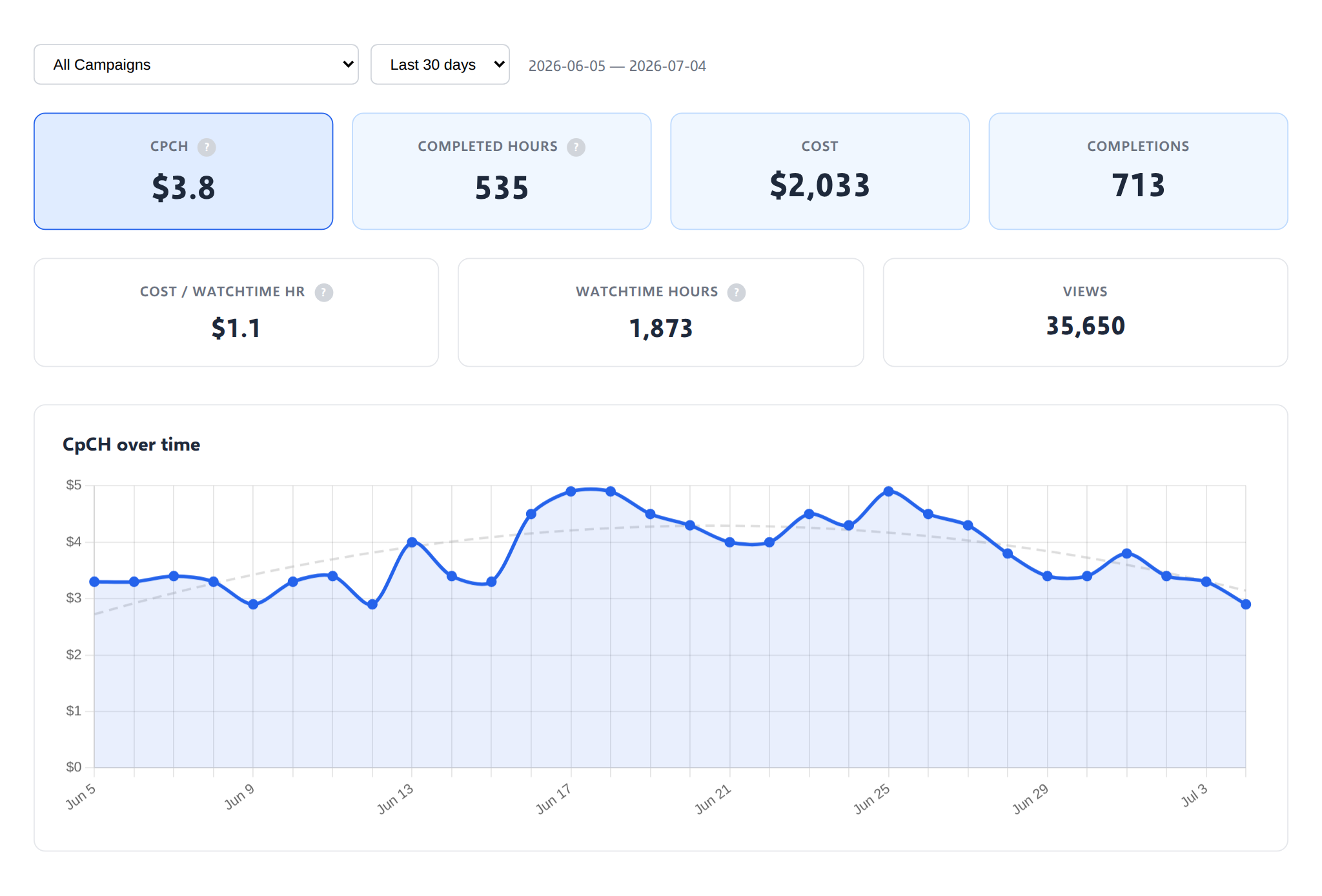
Track the one metric Google can’t optimize: Cost per Completed Hour.

Clear actions, not raw data. Adjust bids, mark done.
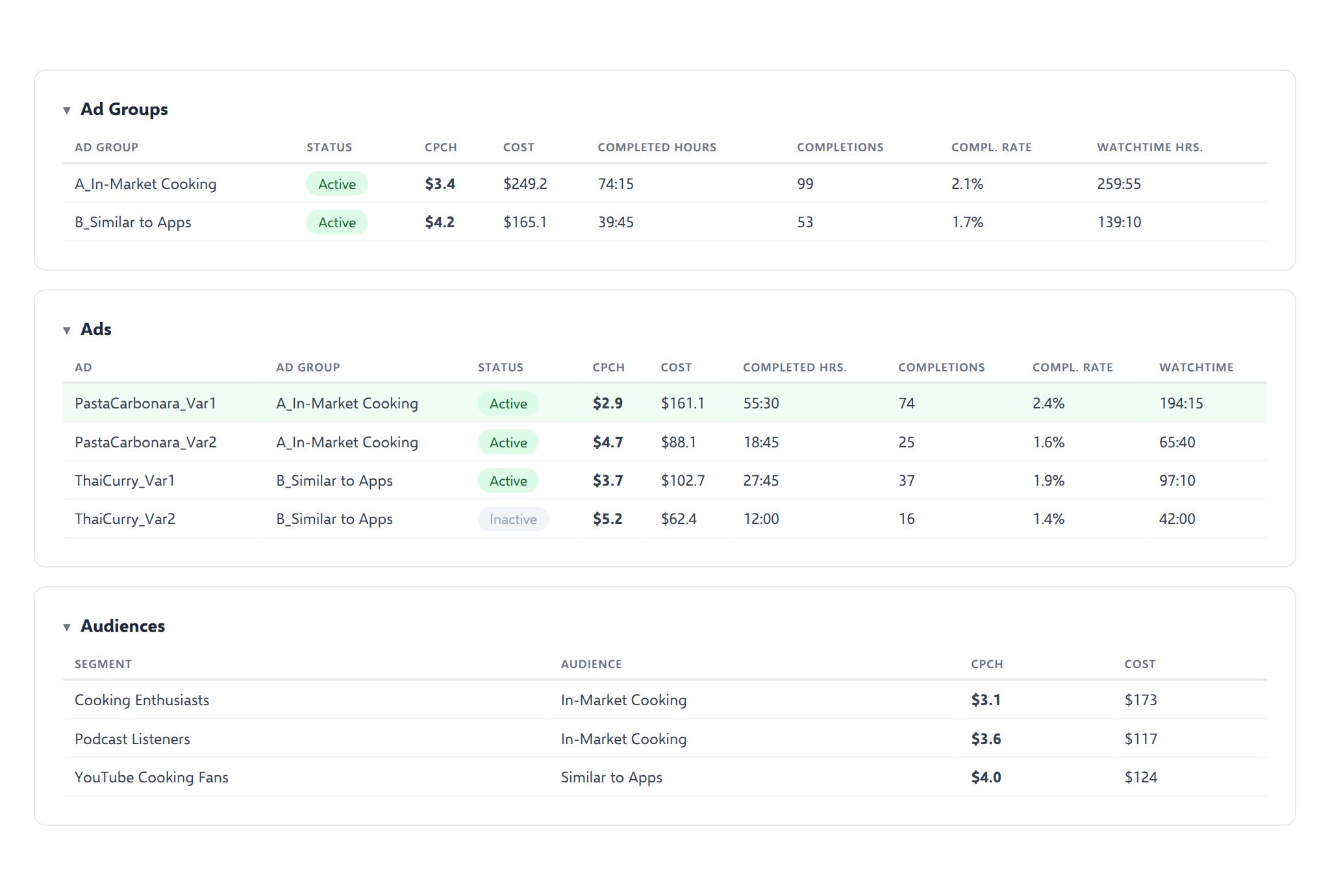
Every ad group, ad, and audience — ranked by CpCH.
Content distribution
Why paid distribution?
Visibility on demand
No waiting to be picked by YouTube. When you pay, your episodes get seen.
New audiences
Put your show in front of completely new audiences — picked by you.
Predictable growth
You can estimate what a budget brings — before you spend it.
Scale with no ceiling
The same episode can reach hundreds of people — or a whole country.
Content recycling
Recycle a great episode from a year ago — push it to new listeners today.
Results in days
Within days you see which episodes earn listens — and adjust course early.
Pick what gets pushed
Promote the work that positions you where you want to be.
Transparent costs
Your spend is one visible, calculable number. You know exactly what it costs you.
Where ads appear
Your episode, recommended
Your episodes run as YouTube in-feed ads: video recommendations placed among organic results — on the home feed, in search, and next to videos.
Nobody gets interrupted at the start of a video. Your ad sits among the unpaid recommendations — people open it because it looks like something they want, and land on your channel’s watch page. Apart from a small Ad tag, it looks organic.
The metric
One metric runs it all: CpCH
Hourcast runs on a metric the world has never had — cost per completed hour (CpCH). It’s what you pay for one full hour of your podcast watched to 100%, start to finish.
It’s the strictest measure of podcast consumption there is. A view means someone watched a few seconds. A completed hour means someone heard your entire episode.
That’s the most valuable attention you can get: nothing about your show is more likely to win a new audience or new business. There’s nothing harder to optimize for.
Google can count views, but it can’t deliver completed hours — its algorithms were built for 25-second spots, not 60-minute podcasts where the value is in someone listening to the end.
Long-form only
Under 7 minutes? Won’t even start
The engine is built exclusively for episodes of 7+ minutes. Shorts and clips are filtered out by design — try to run one, and the engine refuses to optimize it.
That’s by design, not a shortcoming. A 30-second clip gets finished by accident. A 45-minute episode gets finished by a listener.
A tool with an opinion
Hourcast takes a side
An ads manager hands you dozens of columns — and leaves decisions to you. Hourcast steers in one direction: toward completed hours and new listeners.
Beyond CpCH, the engine runs its own rewards and penalties. Ads that bring extra value — like outsized visibility for the money — get rewarded. Ads with weak visibility signals get penalized.
The setup
Growth that compounds
Connect your account
Runs inside your own Google Ads account — set up in 10 minutes.
Set your budget
You decide the total. A hard limit — never crossed.
The algorithm takes over the grind
It shifts budget where a completed hour costs the least — and hands you Actions to apply.
First weeks
First numbers
Your first data lands: spend, completions, and what a completed hour costs you.
Budget shifts
With enough video completions, budget starts moving toward your winners.
Results compound
Accuracy climbs, weak ads surface as Actions, and every dollar works harder.
Your show deserves the engine
Connect your account in 10 minutes — the algorithm starts learning your show the same day.
No card · Cancel anytime · $30/month after trial
Proprietary technology
The only algorithm built around completed hours
A view is no proof anyone watched — in Google ecosystem, a 3-second skip and a finished 45-minute episode can look almost the same. The metric a podcaster needs simply isn’t in there.
That’s what Hourcast’s custom algorithm was built for:
Spend, completions, devices, screens, CTV — every signal the campaigns produce, for every single ad.
Computed per campaign, per ad, per device etc. — a metric that exists nowhere in Google Ads.
Toward your most successful episodes within their campaign groups — following dozens of decision rules.
Ads that spend without completing, devices that underdeliver — flagged as recommended Actions. You review, you apply.
Views vs. hours
Why completed hours
A view is a moment. A completed hour is a listener. What does one cost you? Organic can’t tell you. Google Ads can’t either. That’s the number the engine measures.
Measured in views
A view means someone pressed play — for maybe three seconds. Whether anyone heard your show, you’ll never know.
Budgets managed on views drift toward whatever gets opened cheaply.
Measured in completed hours
A completed hour means someone heard you out — chose your episode and stayed to the very end.
Two people finish your 30-minute episode = one completed hour. Its cost is what the algorithm minimizes.
VS
And keep doing what already grows you — consistent uploads, titles, thumbnails. Hourcast adds the lever they don’t have: paid distribution.
Your money, your rules
Rules it can never break
A/B test
Control vs. Optimized
Hourcast has a built-in A/B test for isolated comparison. Set up two identical campaigns — same settings, same targeting, same episodes.
One runs as the Optimized campaign. The other stays untouched, as your Control campaign.
Then compare what a completed hour cost in each — side by side, in your own account. Run the proof yourself.
VS
Paid + organic
Two lanes. One audience.
Ads run in their own slots. Your organic reach stays as it is — the two don’t compete for the same spot.
Louder together
Paid
Growth, in their words
Before Hourcast was a tool, it was a service. These clients were first.
“Organic keeps recommending me to the same kind of people. I wanted out of that bubble.”
I cover ETFs, crypto, personal finance. Organic worked well, but recommendations keep landing with similar people. With paid promotion I now reach completely new audiences on top of an already strong channel. Paid viewers aren’t passive: they like, comment, and boosted episodes keep living for months. Completions, viewers, subscribers — everything is climbing.
JakubFounder & Host, trading and personal finance channel
“We were skeptical. Then we understood: completed hours are trust.”
Podcasts put our founders in front of people as faces they know — instead of bombarding them with sales ads. We doubted this method at first, but we’ve seen that people genuinely watch full episodes. Self-reported attribution tells the real story: clients say the podcasts are what made them invest. That’s why we invest in this kind of visibility.
PeterHead of Marketing, an investment company from CEE
“A way to buy the highest-quality time someone can spend with your podcast. A genuine invention.”
I do the podcast alongside my other work, so I don’t have time to babysit campaigns. This runs, reports, and I just decide what to scale. And it’s completely transparent — I see the exact impact of every euro, no black box.
NicoleMarketer & Host, marketing podcast
“We compared the cost of a completed hour against every channel we buy. As a source of visibility, it absolutely makes sense.”
People need to know a brand like ours before they buy from it. So we did what we always do: put the numbers next to every other channel we run. An hour of someone watching our content to the very end holds up against anything comparable we buy. It earned its place in the mix.
GabrielCEO, European e-commerce brand
Straight answers
Could you do this without the tool?
Partly. There are strategies that chase a similar outcome — organic tactics, hand-tuned campaigns, digging through reports. Plenty of them work.
What none of them give you is the whole machine: one tool that manages your entire paid growth — measuring, judging, moving budget, handing you Actions.
For the engine to work on your show, three things need to be true:
FAQ
Under the hood
Does Hourcast take control of my Google Ads account?
No. You paste one script into your own account and authorize it through Google’s standard screen — no admin access handed over. It’s transparent: you see exactly what data it sends, and it only reads your YouTube Video campaigns, not your conversion or other campaigns.
Does it change my ads or targeting on its own?
No. Pausing an ad or adjusting a bid is a Recommended Action — you decide and apply it. Nothing edits your ads or targeting on its own.
What does the script actually read?
Only your YouTube Video campaigns — spend, completions, and device signals for every ad. It doesn’t fetch your conversion campaigns or the rest of your account.
What ads does Hourcast work with?
Three rules, and they’re strict: one video per ad, episodes 7+ minutes, and in-feed placement only — no in-stream, no Shorts. An ad that breaks one gets flagged and skipped. The engine only optimizes what fits long-form watching.
Why does the same episode cost so much more on some devices?
More than you’d expect. The same episode can cost a few dollars per completed hour on a TV screen and several times that on a phone — people commit to a big screen and drift on mobile. Hourcast breaks every number down by device and hands you the bid adjustments to match. It’s often the single biggest lever in your account.
Can I re-promote an old episode?
Yes — and it’s one of the best moves you can make. A proven episode from a year ago sometimes outperforms newest upload. Push it back in front of new audiences; if people finish it, budget flows to it.
What’s the biggest lever I control?
Two, and both are yours. The content itself is the biggest — a strong episode is what earns completed hours. The thumbnail is second: a distinct one per ad variation moves what a completed hour costs you. Hourcast shifts budget and hands you Actions, but it never touches your creative.
What’s a good CpCH?
There’s no universal benchmark — the metric is new, and it varies by show and audience. The number that matters is your own: track it over time and work it down. After a month, your own average becomes your baseline.
What does a completed hour cost without this optimization?
A standard algorithm optimizes the first few seconds — the view, the decision to stay or skip — not the next 40 minutes. A 42-minute episode has 2,520 seconds where someone can drop off, and it’s blind to all but the first few. Without CpCH optimization a completed hour commonly costs 10 to 20 times more. At the extreme we’ve seen 50x.
Does watching 95% count as a completed hour?
Only a full play counts — the whole episode, start to finish. A 95% watch isn’t a completed hour; it’s 100% or it doesn’t count.
How does the engine get better over time?
-
It gets tested: every change is replayed against 120 days of a real account’s history before it runs on a live budget.
-
It gains functionality: format protection, audience-level cost reporting, day-one ranking — none of it existed at launch.
-
The decisions get more precise: Actions that once needed a specific targeting setup now work on any account.
Every release since April 2026 is dated in the changelog.